A Giant Sucking Sound
I don't believe in psychics, astrology, or a product roadmap slide with dates on it. They all sell false certainty about a future nobody can see.
So it's a little awkward that I want to start with a prediction that came partly true.
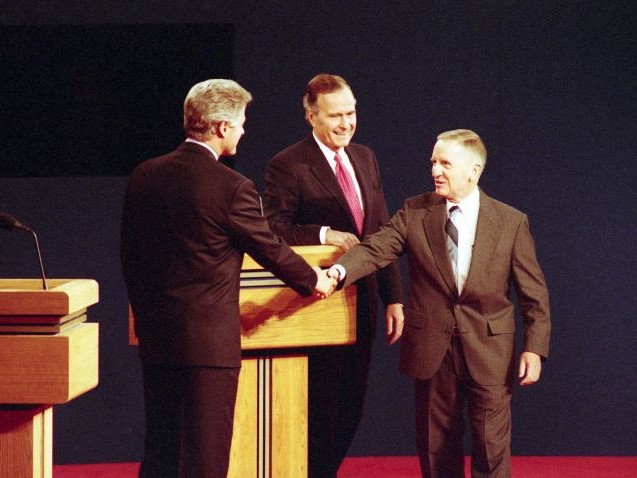
October 1992
In October 1992, a plainspoken Texas billionaire named Ross Perot stood on a debate stage next to a sitting president and the governor of Arkansas and warned the country about a trade deal called NAFTA. If a company could move its factory to Mexico, pay a dollar an hour, and skip health care, pollution controls, and retirement, he said, there would be "a giant sucking sound going south."
Perot was running as an independent. He finished with nearly 19 percent of the popular vote, the strongest third-party showing since Theodore Roosevelt in 1912. He lost. Clinton won, pushed NAFTA's implementing legislation through Congress, and the agreement took effect on January 1, 1994.
Three decades later, "giant sucking sound" is shorthand for a warning that came true. That's only half right. The half that's wrong is the useful part.
Right Direction, Wrong Door
Start with what the evidence says about NAFTA itself.
At the national level, the effect was small. The Congressional Budget Office looked in 2003 and found NAFTA's impact on U.S. GDP to be very modest. The U.S. International Trade Commission reached a similar conclusion in 2016. In an economy of well over 100 million jobs, NAFTA was not the jobs apocalypse its opponents predicted — or the boom its supporters promised.
At the local level, it was a different story. Economists Shushanik Hakobyan and John McLaren traced NAFTA's effects down to specific industries and towns. Workers in the places most exposed to Mexican import competition saw substantially slower wage growth through the 1990s, and the damage fell hardest on workers without a college education. The pain was real. It was concentrated. And national averages hid it.
So Perot was directionally right about the pressure and about who would feel it. He was wrong about the size. More importantly, he was watching the wrong door.
In 2000, Congress granted China permanent normal trade relations. In December 2001, China joined the World Trade Organization. U.S. manufacturing employment stood at roughly 17.3 million at the start of 2000. By early 2010, it was about 11.5 million.
Not all of that was trade. Automation and two recessions did plenty of the work. But the research on the China shock is hard to wave away. David Autor, David Dorn, and Gordon Hanson estimated that rising Chinese import competition explains roughly a quarter of the decline in U.S. manufacturing employment from 1990 to 2007. A follow-up study led by Daron Acemoglu put total U.S. job losses from that competition at 2.0 to 2.4 million between 1999 and 2011, once you count the suppliers and local businesses that went down with the factories. Justin Pierce and Peter Schott showed the decline was unusually swift after 2000, and concentrated in exactly the industries where China's new trade status removed the most uncertainty.
The 1992 debate was about Mexico. The decisive blow arrived a decade later, from somewhere else.
That's my real problem with predictions. Not that they're always wrong. Perot wasn't. It's that even a directionally correct prediction points you at one door, and the disruption that matters most tends to come through another one. Anyone who prepared only for the NAFTA scenario prepared for the wrong one.
The Response
If Perot's warning was right enough, what did the country do about it?
The main federal answer was Trade Adjustment Assistance. TAA dates to 1962. NAFTA created its own version in 1994, and the Trade Act of 2002 folded the programs together. The idea was sound: income support, retraining, and help with job search and relocation for workers who lost jobs to trade.
The results were mixed at best. A Department of Labor–commissioned evaluation by Mathematica Policy Research, published in 2012, found that TAA participants were still earning less than comparable displaced workers four years later, largely because time spent in training delayed their return to work. A later study by Benjamin Hyman, using quasi-random assignment of cases, found more encouraging earnings gains — but the gains shrank over time. Take-up was low throughout. Many eligible workers never enrolled.
The places didn't recover either. In 2021, Autor, Dorn, and Hanson revisited the communities hit hardest by the China shock and found employment still depressed nearly two decades later. Workers mostly didn't move to where the jobs were. Earlier work by the same team had found rising reliance on disability and other transfer payments in those same places.
The problem was real. The framing was right. What got lost was a practical path forward.
"Learn to Code"
Then came the slogan.
"Learn to code" arrived later than most people remember. It belongs to the 2010s, not the 1990s: the rise of Code.org and coding bootcamps, retraining programs aimed at laid-off coal miners in Appalachia, and Joe Biden telling a New Hampshire crowd in December 2019 that anyone who could throw coal into a furnace could learn to program. By then, the phrase had already curdled into an online taunt aimed at laid-off journalists.
As advice to an individual, it sometimes worked. As policy for a displaced workforce, it failed, and the reasons are not mysterious:
- Age. A 52-year-old with a mortgage is not in the same position as a 22-year-old with time to burn.
- Geography. The jobs were in Seattle and Austin. The workers were in eastern Kentucky and southern Ohio.
- Credentials. Hiring filters screened out career changers long before anyone looked at their skills.
- Fit. Not everyone wants to write software, and not everyone who tries is good at it.
- Time. The payback period was longer than most families could afford to wait.
Underneath all of that was a deeper problem. "Learn to code" moved the entire burden of adjustment onto the individual. The system broke; the worker was told to fix himself.
Then and Now
So what carries over to AI, and what doesn't?
Who is exposed. This time, it's white-collar work. A 2023 study by researchers at OpenAI and the University of Pennsylvania estimated that about 80 percent of U.S. workers have at least 10 percent of their tasks exposed to large language models, and about 19 percent have at least half. Unlike the China shock, exposure rises with wages, not falls.
What the early evidence shows. It points in two directions at once. Erik Brynjolfsson, Danielle Li, and Lindsey Raymond studied customer support agents using a generative AI assistant and found an average productivity gain of 14 percent — and 34 percent for the least experienced workers. That's augmentation, not replacement. But in 2025, Brynjolfsson, Bharat Chandar, and Ruyu Chen found that workers aged 22 to 25 in the most AI-exposed occupations saw roughly a 13 percent relative decline in employment since late 2022, while older workers in the same occupations held steady or grew. The bottom rungs of the ladder are where the strain shows first.
Speed. Moving a factory to Mexico or Guangdong took years of capital planning. A model update ships overnight. To be fair, organizations adopt technology far more slowly than the technology itself improves. But the ceiling on speed is much higher than it was.
No single lever. NAFTA was a treaty. It could be debated, voted on, and in theory renegotiated. China's WTO entry was a policy decision. AI has no vote. It diffuses through software procurement, inside firms, one workflow at a time.
Geography. Here the analogy breaks, and it should be said plainly. Trade hit mill towns. AI exposure is likely to concentrate in knowledge-work metros and in the back offices of every industry. That may mean less of the place-based devastation we saw in the Rust Belt, or it may mean a kind of damage that's harder to see because it's spread across a million cubicles instead of a few hundred plant gates.
The new slogan. "Learn AI" is this decade's "learn to code." It deserves the same test. If it means retraining into a different career, it will fail for the same reasons. If it means something else, that something needs to be stated precisely.
What Individuals Can and Can't Do
I want to be honest about the limits of what follows in this series.
Nothing I write about personal strategy fixes structural displacement. TAA showed what happens when the policy response is designed after the fact, under-funded, and slow: it doesn't catch most of the people it was built for. If AI displacement turns out to be broad, it will need a response at that scale, and no amount of individual initiative substitutes for it.
But individuals can't wait for policy, and there is a distinction that matters.
Retraining into someone else's job is the "learn to code" model. It asks you to abandon what you know and compete as a beginner somewhere new. Extending the reach of the job you already have is different. It keeps your experience and judgment at the center and uses new tools to push past the edges you used to stop at.
That second approach has limits too. It works best for people who already have enough experience to evaluate what the tools produce. It is hardest for exactly the early-career workers the research shows are most exposed. That's not a reason to dismiss it. It's a reason not to oversell it.
Several Futures
Perot was right enough. It didn't matter.
The prediction wasn't the failure. The response was. And the biggest shock came from a direction almost nobody was looking in 1992.
So I'm not going to make predictions about AI and white-collar work. And I'm not going to hand you a tidy answer, because there isn't one. What I do know: the people who come through disruptions intact rarely guessed right. They got ready for several futures, not one.
For me, that preparation comes down to a handful of strategies and systems I've been putting in place. The first is in The Wall That Wasn't.
Sources
- Congressional Budget Office, The Effects of NAFTA on U.S.-Mexican Trade and GDP (2003)
- U.S. International Trade Commission, Economic Impact of Trade Agreements Implemented Under Trade Authorities Procedures (2016)
- Hakobyan & McLaren, "Looking for Local Labor Market Effects of NAFTA," Review of Economics and Statistics (2016)
- Autor, Dorn & Hanson, "The China Syndrome: Local Labor Market Effects of Import Competition in the United States," American Economic Review (2013)
- Acemoglu, Autor, Dorn, Hanson & Price, "Import Competition and the Great US Employment Sag of the 2000s," Journal of Labor Economics (2016)
- Pierce & Schott, "The Surprisingly Swift Decline of US Manufacturing Employment," American Economic Review (2016)
- Autor, Dorn & Hanson, "On the Persistence of the China Shock," Brookings Papers on Economic Activity (2021)
- Schochet et al., Estimated Impacts for Participants in the Trade Adjustment Assistance (TAA) Program Under the 2002 Amendments, Mathematica Policy Research for U.S. DOL (2012)
- Hyman, "Can Displaced Labor Be Retrained? Evidence from Quasi-Random Assignment to Trade Adjustment Assistance" (2018)
- Eloundou, Manning, Mishkin & Rock, "GPTs are GPTs: An Early Look at the Labor Market Impact Potential of Large Language Models" (2023)
- Brynjolfsson, Li & Raymond, "Generative AI at Work" (2023)
- Brynjolfsson, Chandar & Chen, "Canaries in the Coal Mine? Six Facts about the Recent Employment Effects of Artificial Intelligence" (2025)
- U.S. Bureau of Labor Statistics, Current Employment Statistics, manufacturing employment series
This content is created independently and is not sponsored by or affiliated with any technology organization. All opinions are my own.